

 Agricultural Autonomy Institute joins Harper Adams University's 125th anniversary celebrations
A leading American expert in agricultural autonomy has paid tribute to Harper Adams University as it marks its 125th anniversary.Dr Alex Tho …
Posted 22 October
Why reducing greenhouse gas emissions - while protecting food production - is vital
4 September 2023

Harper Adams University’s Deputy Vice-Chancellor, Professor Michael Lee, represents the UK within the Animal Task Force.
The Task Force is a European Public-Private Think Tank to advise on European Union and National Governments’ Policies for sustainable livestock, and has just launched a new policy brief on Agricultural Methane.
In this blog, he explains more about the brief – and why it is so important.

The Paris Agreement, a legally-binding international treaty on climate change, has been at the forefront of its adoptees’ work in combatting climate change and its affects since 2015.
Our new brief has been developed to greater reflect the urgency of the Agreement’s Article 1a – which aims to hold the increase in global temperature to below two degrees Celsius above pre-industrial levels - but, at the same time, uphold its commitment to Article 1b – which reflects the need to reduce greenhouse gas emissions whilst not threatening food production.
To do this, we need to reduce all major greenhouse gases (GHG) – Carbon Dioxide, Nitrous Oxide and Methane.
Our new brief recognises and acknowledges this fact - but also notes the danger of converting all GHG’s into a common Carbon Dioxide equivalent, as each gas behaves differently in the atmosphere.
Carbon Dioxide and Nitrous Oxide are stock pollutants, which accumulate over time, and so need to be tackled by reducing fossil fuel derived emissions to zero; whereas Methane is a flow pollutant, which breaks down more readily in the atmosphere. This means its levels needs be brought down to a level which balances production and removal, around a 30 per cent reduction in current levels.
The brief also emphasises the importance of defining a GHG as either: a biogenic GHG, which is part of a natural cycle – such as biogenic Carbon Dioxide, which is released through respiration, or biogenic Methane which is released through plant fermentation in the gut of herbivores; or a fossil GHG – this is the carbon locked up for millennia and released by humans in fuels such as coal, oil and natural gas.
So - what does this mean for Methane and the Paris Agreement’s Articles 1a and 1b?
Approximately 40 per cent of global Methane emissions come from natural sources, 30 per cent are from agriculture – predominately via ruminant herbivores – and the remaining per cent are from fossil fuels.
Therefore, quite simply: to ensure we keep to both the 1a and 1b agreements, we need to refocus our efforts on fossil fuel Methane reduction.
This is not to say we should not reduce emissions in agriculture, of course we should - and we are - but to deliver the biggest gain, the focus for complete removal and Net Zero has to be on fossil fuel use and not ruminant herbivores, which too often appears to be the focus concerning methane.
The emission of Carbon Monoxide via fossil fuel burning also suggests that we need to focus our efforts on their use.
When fossil fuels are burnt for energy, they predominately release two carbon-containing gases, Carbon Dioxide, which is a greenhouse gas, and Carbon Monoxide, which although is not a direct GHG, reacts in the atmosphere removing Hydroxy radicles.
Yet it is these very same Hydroxy radicles that react and breakdown Methane – removing it from the atmosphere.
So more fossil fuel burning means more carbon monoxide and fewer hydroxy radicles, which may slow removal of Methane. More research is needed to better understand the impact of hydroxy radicles in the atmosphere as their concentration is not equally distributed across space and time.
Concentrating on fossil fuel Methane is a win-win-win: less GHG will be emitted in the first place, there will be fewer pollutants that reduce the ability to remove all biogenic Methane, (such as Methane produced from cow's burps), and we respect the commitment to Paris Agreement Article 1b to protect vital food production.
Related Posts
Agricultural Autonomy Institute joins Harper Adams University's 125th anniversary celebrations
A leading American expert in agricultural autonomy has paid tribute to Harper Adams University as it marks its 125th anniversary.Dr Alex Tho …
Posted 22 October
 Sky's the limit: Helen joins MP's fundraising parachute jump
A charity skydive by a Harper Adams University Business Development Consultant has helped raise more than £16,000 for a new cancer cen …
Posted 21 October
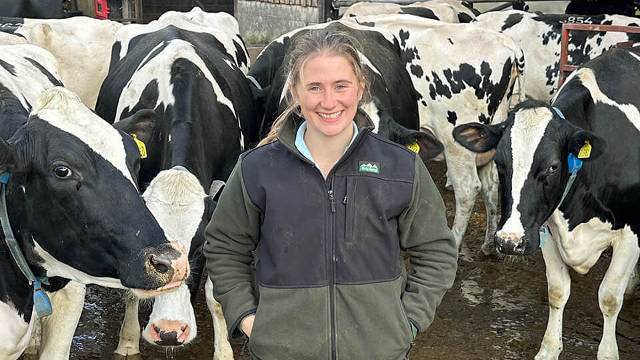 From dairy farm - to farm vet
Growing up on a dairy farm played a huge part in shaping Harriet Brimacombe’s ambition to become a vet. Now, as she prepares to …
Posted 20 October
 Listen: Archers anniversary marked with future of farming discussion on BBC radio
With BBC Radio Four marking the 75th anniversary of the Archers this year, Farming Today has taken the opportunity to look forwards this wee …
Posted 16 October